


Artificial intelligence is reshaping life sciences at speed, and success will depend on how organisations build capability around it. Workforce data shows professionals are ready to adapt, while leaders recognise the scale of reskilling required. For HR, this is a strategic moment. From mapping skills and redesigning workflows to integrating flexible expertise and managing cognitive load, AI adoption demands deliberate workforce transformation. Organisations need to apply the same discipline used for regulated change, while investing consistently in their people, to build confident, adaptive teams ready to move forward.
In this article
- How life sciences leaders view AI adoption and workforce risk
- How HR can build a workforce strategy for AI adoption
- Upskilling in action: from isolated AI pilots to cross-functional experimentation
- How can HR create a blended AI-ready workforce in life sciences?
- How to keep employees engaged while avoiding cognitive overload
- Why HR will determine the success of AI adoption in life sciences
We’re all digital immigrants. Mass AI adoption is driving a new digital migration that touches every organisational function. In life sciences, it is reshaping how scientists analyse data, how compliance teams manage documentation, how supply chains forecast demand, and how leaders make decisions.
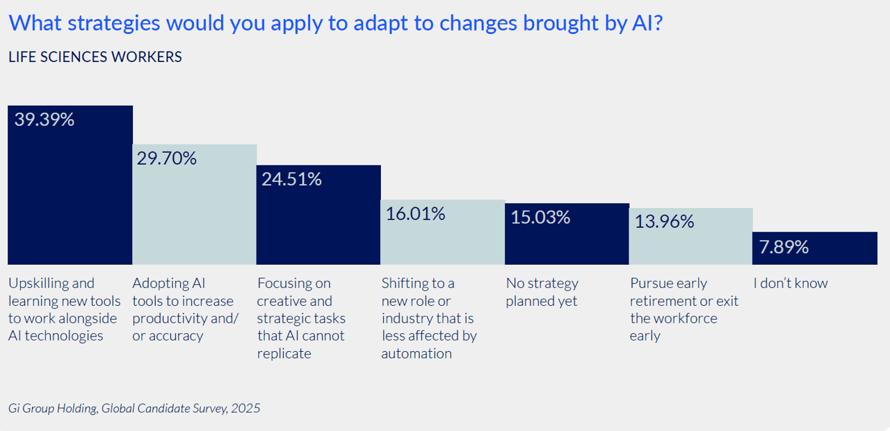
The workforce response to AI is more curious than resistant. In Gi Group Holding’s Life Sciences Global HR Trends Report 2026, 39% of professionals across 20 countries say they plan to upskill and learn new tools to work alongside AI technologies. A further 30% intend to adopt AI to increase productivity or accuracy, and 25% want to focus more on creative and strategic work.
At the same time, hesitation is visible. 15% have no strategy planned yet.
Some are considering moving into roles or industries less exposed to automation, while others are weighing early retirement. Curiosity and uncertainty sit side by side.
HR plays a key role. It must map the skills the organisation will need, co-design learning pathways and practical use cases with IT and business teams, particularly for non-technical functions, and guide adoption in a way that protects focus and energy.
That means helping people choose the right tools, build relevant capability, and understand where automation supports human judgement.
AI adoption is a challenge to change management wrapped in a talent strategy.
And it places HR at the centre of decisions about how work evolves.
How life sciences leaders view AI adoption and workforce risk
For many life sciences organisations, AI is already moving into core processes.
For others, the opportunity is clear and fast-approaching.
According to Deloitte’s 2025 Global Health Care Outlook, many administrative processes are still handled manually and could be automated using generative AI and other digital technologies. Referrals, scheduling, and documentation often require repeated data entry and coordination, consuming valuable clinical and administrative time.
Automating routine workflows would reduce friction across systems and allow skilled professionals to focus their expertise where it has the greatest impact.
In the same Deloitte survey, most health system leaders said their organisations are developing use cases or planning to explore generative AI within the next 12 months. More than 40% reported a significant-to-moderate return on their generative AI investments so far, while 37% said it is still too early to assess impact.
Adoption is advancing, even as outcomes continue to be monitored.
However, leadership concern around AI skills is rising. The World Employment Confederation’s The Work We Want report found that 85% of life sciences leaders believe AI and other technological disruption will require companies to rethink skills and resources across large areas of the workforce. Seventy-two per cent are concerned their organisation will not be able to train employees fast enough to keep pace.
This potential impact of AI is echoed on both sides of the workforce conversation. In Gi Group our study, 29% of life sciences professionals say increased automation and AI integration will have the biggest impact on their own careers in the next three years.
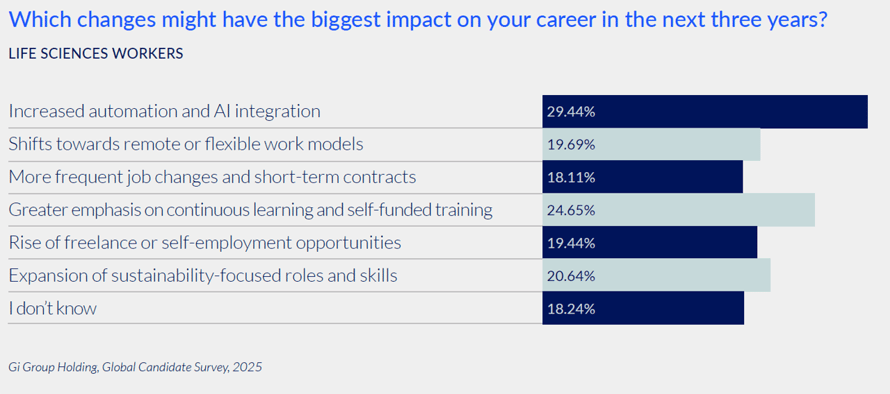
Different datasets point in the same direction. AI is transforming operations, and its success depends as much on people capability as on technology investment.
How HR can build a workforce strategy for AI adoption
Using AI tools effectively is quickly becoming part of everyday work.
As workflows evolve, so do expectations, and the mental load on employees increases.
Research from the McKinsey Health Institute highlights that AI-enabled transformation must be paired with deliberate investment in “brain skills”, including judgement, creativity, learning agility, and communication. Without that balance, productivity gains can quickly give way to overload.
For HR leaders, the challenge is to ensure AI is integrated into workflows in a way that strengthens human capability. That requires deliberate choices about how work is redesigned, how skills are built, and how cognitive load is managed. Three priorities stand out:
1. Design augmentation-first operating models
Rather than starting with what can be automated, start with how AI helps people perform their core responsibilities more effectively.
In practice, this means automating transactional tasks where human input adds limited value, augmenting analytical and scientific work where judgement remains critical, and deploying agentic tools to improve productivity across functions. It also means being transparent about what is changing and why. When employees understand how AI enhances their contribution, adoption strengthens.
Moderna’s partnership with OpenAI shows what happens when AI is treated as infrastructure.
The organisation deployed ChatGPT Enterprise across research, legal, manufacturing, and commercial teams, embedding AI directly into core workflows. In clinical development, an internal GPT known as Dose ID was built to review and analyse complex trial datasets.
Life sciences organisations operate in highly regulated environments where accuracy and accountability matter. An augmentation-first approach reflects that reality.
Technology should strengthen professional judgement and help experts work with greater focus and rigour.
2. Adopt a layered talent strategy
The debate around AI talent is often framed as a choice: recruit AI specialists, reskill the existing workforce, or outsource. In reality, sustainable transformation usually means layering all three.
Specialist AI talent can drive innovation and set standards. Internal reskilling builds long-term capability and signals commitment to employees. External consultants and temporary specialised workers can accelerate implementation and transfer knowledge into the organisation.
Blended workforce models reduce risk while building internal strength.
The key is coordination. Layered approaches only work when HR has visibility across capability planning and implementation timelines.
3. Map skills before scaling training
Broad “upskill everyone” campaigns often start with energy but lose momentum. When learning lacks focus, employees feel stretched and uncertain. A clear skills audit brings direction.
Where does AI introduce genuinely new value? Which roles will require deeper technical fluency, and where will augmentation support existing expertise? Some functions will require deeper technical capability, others practical fluency. A clear understanding of the current landscape and broader business goals ensure development is concentrated where it will make a difference.
Develop tiered learning pathways for different roles, from scientists and regulators to commercial and operational teams. Anchor training in real organisational use cases over generic AI theory.
Leading life sciences organisations are already moving in this direction.
AstraZeneca has launched enterprise-wide AI learning pathways in multiple languages and partnered with MIT and Harvard to strengthen genetic data analysis skills.
At Johnson & Johnson, more than 56,000 employees have completed mandatory generative AI training, supported by broader digital boot camps covering AI and related technologies.
Structured capability-building reduces anxiety and prevents cognitive overload.
It signals that AI adoption is planned and led with intent.

Upskilling in action: from isolated AI pilots to cross-functional experimentation
In many organisations, AI has moved beyond small specialist pilots.
Cross-functional teams are testing how intelligent tools fit into real workflows.
Innovation sprints now focus on operational challenges such as accelerating drug discovery or reducing compliance workload. Scientists, engineers, regulatory, and commercial teams work together to test ideas in context. The value often lies as much in shared understanding as in the solution itself.
Merck KGaA has launched an Agentic AI Hackathon in collaboration with AWS and NASSCOM to explore practical generative AI applications. Pfizer has hosted an AI Festival to encourage ideas from across the organisation, while Novo Nordisk has run engineering hackathons to strengthen digital capability. AI is becoming embedded in how internal teams learn and collaborate.
When experimentation is grounded in real work, confidence grows.
Teams see where technology adds value and where it needs refinement.
Integration becomes a deliberate process that employees help shape.
How can HR create a blended AI-ready workforce in life sciences?
Even with focused reskilling, AI capability gaps do not close overnight. In specialist areas such as model deployment, data engineering, and AI governance, demand can outpace internal development. For HR teams, the question becomes how to keep progress moving while protecting long-term capability and confidence.
WEC data shows that 85% of life sciences leaders see agency workers with existing technology expertise as an effective way to spread understanding within permanent teams. Twenty-nine per cent hire agency workers to access specific digital skills they struggle to secure permanently, and 25% expect to rely most heavily on flexible talent to support innovation and AI deployment.
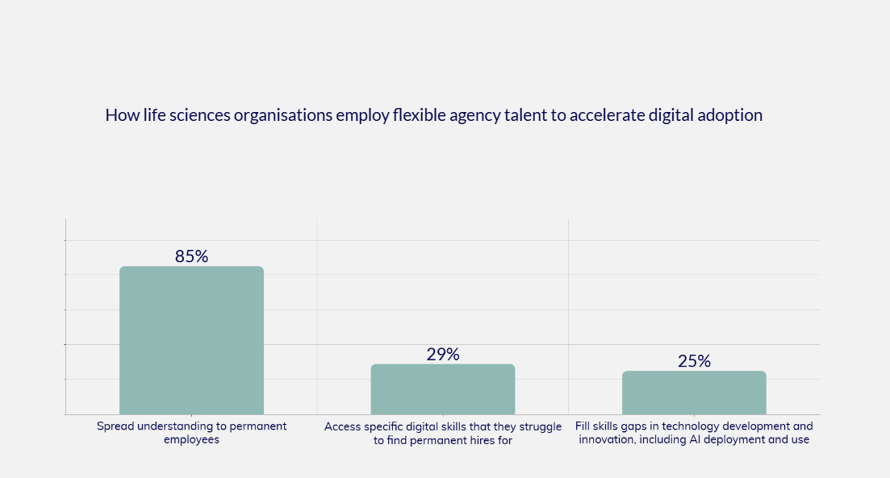
When brought in thoughtfully, external specialists can accelerate delivery and share practical experience, while permanent teams provide continuity and context. HR’s role is to make sure that collaboration strengthens internal expertise over time, so that short-term flexibility becomes long-term capability.
How to keep employees engaged while avoiding cognitive overload
AI adoption fails when people feel overwhelmed and unsure.
New tools, expectations and workflows can feel like too much to juggle.
HR can help avoid overload by taking practical steps to set employees up for success.
1. Create an HR-led AI readiness framework
AI adoption is organisational change. HR should partner with IT and business leaders to co-design implementation roadmaps that embed change management from the start. That means clear communication about reskilling pathways, transparency around how roles will evolve, and visible ownership of the transition. HR leaders should monitor burnout signals alongside adoption metrics and adjust pace where needed. As operating models move towards intelligent platforms, clarity about how work is orchestrated through these systems is essential.
2. Establish thoughtful tool governance
Rolling out multiple AI tools at once creates confusion and overload. In a regulated sector such as life sciences, careful selection is also essential for compliance. Be clear about which problems justify AI and which approved tools meet regulatory requirements. Clear guidance helps teams focus and build real expertise. Prioritise end-to-end integration across R&D, manufacturing, commercial, supply chain, and compliance.
3. Recognise and reward new capability
If AI literacy matters, it should be reflected in progression and reward. Create incentives for employees who develop digital capability and act as internal champions. This signals long-term commitment. Productivity gains from agentic AI and intelligent platforms should create opportunities to move into higher-value, strategic work rather than compete with automation.
4. Design operating models that can adapt
AI will continue to evolve. Operating models must evolve with it. Build feedback loops where insights from AI and advanced analytics shape not only business decisions, but also how work develops. Encourage experimentation in real workflows and shared learning across teams. When the organisation functions as an adaptive network, innovation can scale at the pace of science without exhausting its people.
Why HR will determine the success of AI adoption in life sciences
AI will continue to evolve, but the real differentiator will be how deliberately organisations introduce it and how carefully they build capability around it. The data shows curiosity from professionals and urgency from leaders, alongside real concern about skills and pace.
For HR teams, this is a shaping role. Decisions about where to focus development, how quickly to scale learning, and when to introduce external expertise will influence whether AI strengthens performance or stretches teams too far. When employees understand how new tools support their expertise and create credible development pathways, adoption becomes steadier and more sustainable.
Life sciences organisations already manage complex, regulated change with discipline. Applying that same care to AI, while investing consistently in people, will determine who builds an adaptive workforce and who creates capability gaps.
And true HR leadership will set the tone for how this transition unfolds.