In life sciences, people power progress.
But many are running on empty.
In our Life Sciences Global HR Trends Report 2026, we took the pulse of workforce wellbeing and found that 35% of employees are considering leaving their current organisation.
When we asked what motivates them to move on, respondents across 20 countries cited improved work–life balance (41%), greater flexibility (34%), more stability and security (33%), and dissatisfaction with company culture or leadership (26%).
Is the industry doing enough to protect its brightest minds?
And what happens when the people who carry specialist knowledge and continuity start to disengage or walk away?
The rise of burnout has become a material capability and retention risk in the industry, as sustained pressure across specialist roles in R&D, clinical functions, quality, and regulatory teams can lead to regretted attrition, reduced performance, and loss of continuity across long programmes.
At the same time, scientific progress and clearer evidence on brain health are strengthening understanding of its role in productivity and resilience. Disruption linked to artificial intelligence is adding further pressure to adapt. Together, these factors are increasing the economic importance of coordinated investment in brain health.
Workforce wellbeing therefore needs to be managed as part of the operating model, not left to individual resilience. That includes workload planning around critical milestones, manager capability, early intervention, and support that is visible and easy to use.
The World Health Organization describes burnout as a syndrome caused by chronic workplace stress that has not been successfully managed. It is characterised by three dimensions:
Crucially, it is defined as an occupational issue. That places responsibility not only on individuals, but on how they are supported and how their work is designed.
In life sciences, the factors relating to burnout are embedded in how the sector operates.
Multi-year research programmes demand sustained focus. Clinical roles carry emotional intensity alongside operational pressure. Regulatory frameworks leave little margin for error. Funding cycles and binary trial outcomes create uncertainty. Heavy workloads and poor work-life balance compound that strain, especially in high-stakes biotech, pharma, and healthcare settings.
Burnout does not sit at one level of the workforce. In one major health system, one third of physicians met criteria for burnout. But it also affects early-career professionals. Research into medical students has shown that burnout, particularly depersonalisation and a reduced sense of personal accomplishment, can predict serious longer-term consequences if left unaddressed, though prevention and recovery reduce that risk.
Moreover, life sciences errors have real-world consequences.
Patient outcomes, trial integrity, GMP and GLP compliance, and audit scrutiny leave little margin for fatigue. Multi-year R&D timelines, funding cliffs, and “always-on” milestones create prolonged load.
For clinical teams, prolonged stress has been linked to lower productivity, reduced job satisfaction, and negative impacts on patient care.
Yet when budgets tighten, workforce wellbeing can slip down the priority list.
In a sector built on specialist knowledge and continuity, this is a costly oversight.
Burnout is costing the global economy $438 billion a year in lost productivity.
In 2024, global employee engagement fell from 23% to 21%.
It is only the second decline in twelve years, the first occurring during the COVID-19 lockdowns and stay-at-home orders. A two-point change is significant at scale, as it indicates a larger share of the workforce operating below full capacity.
But reduced productivity is only part of the picture: there is also a significant growth opportunity being overlooked. Research from the McKinsey Health Institute suggests that proactive investment in employee health, including mental health, could increase global GDP by up to 12% and generate up to $11.7 trillion in economic value.
On the other hand, failure to act has consequences.
When support is limited, or when unfair treatment and sustained time pressure become routine, burnout accelerates.
Even before employees leave, the effects are visible.
Those experiencing high burnout become less invested in their work and their teams.
Collaboration weakens. Job satisfaction drops.
Engagement becomes conditional rather than committed.
Over time, withdrawal reshapes team dynamics and undermines shared goals.
It’s worth highlighting that turnover is rarely straightforward in life sciences, and the business impact can be significant. Replacing a specialist can mean rebuilding regulatory expertise, restoring trial continuity, and re-establishing trust across cross-functional teams.
Years of accumulated knowledge and judgement can disappear in a matter of weeks.
While the financial cost can be calculated, the disruption to momentum and team confidence is often far harder to quantify.
Awareness around the benefits of wellbeing is already there.
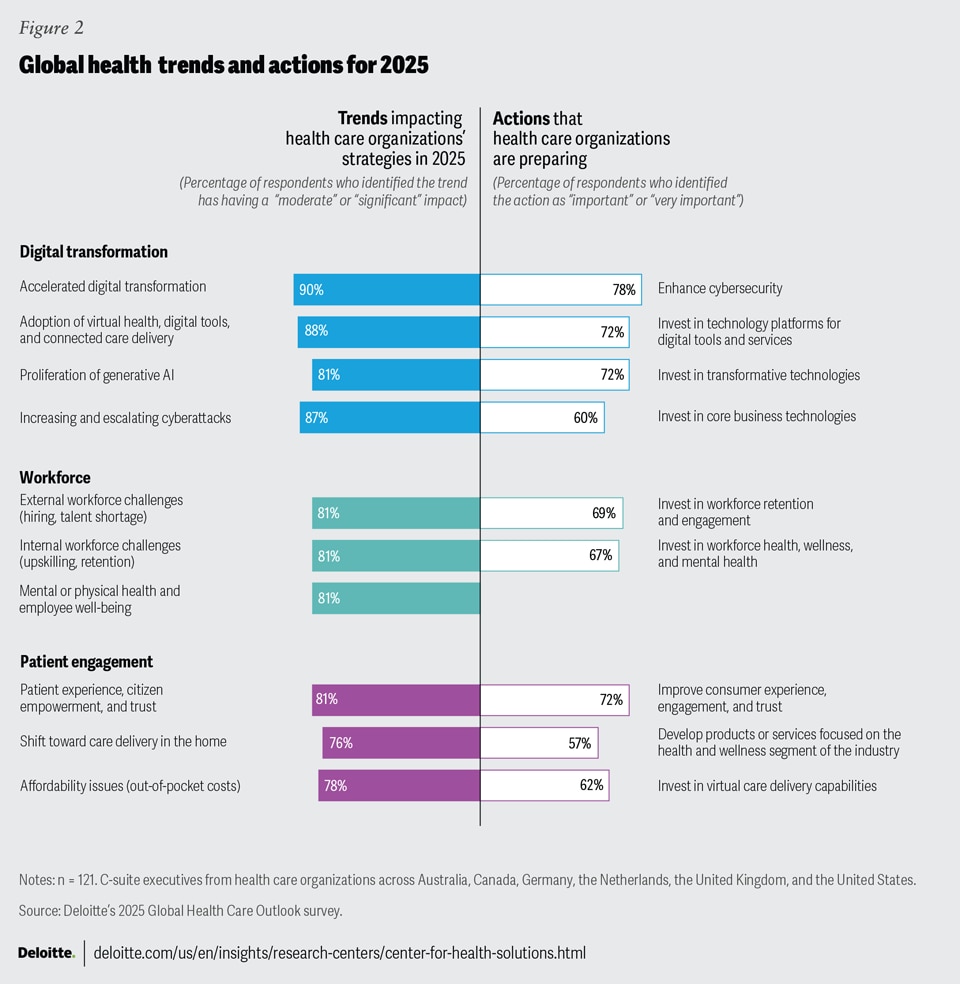
According to Deloitte’s Global Health Care Outlook Survey 2025, 81% of life sciences C-suite respondents identified mental or physical health and employee wellbeing as having a moderate or significant impact on their organisational strategy. Intent is also strong. Deloitte’s survey reveals that 69% of life sciences leaders say they are planning to invest in workforce retention and engagement, and 67% consider investment in workforce health, wellness, and mental health to be very important.
Leaders understand that wellbeing matters.
Here are some of the ways they can turn that awareness into consistent, practical action.
When life sciences professionals consider a job offer, stability and balance are high on their priority lists. According to our Life Sciences Global HR Trends 2026 data , 39% cite job stability and security as their primary reason for accepting an offer. Work-life balance follows at 35%, while 28% highlight flexible working options such as remote work or adaptable hours.
When we asked them which additional benefits would make an employer stand out, they prioritised practical support. Extra paid time off ranked highest at 45%, followed by enhanced healthcare coverage at 38%. Wellness programmes are important to 31%, and 21% value childcare or family support.
These preferences map neatly to burnout prevention.
Stability reduces uncertainty in a sector shaped by funding cycles and regulatory scrutiny.
Work-life balance protects sustained energy. Flexibility gives professionals greater control over how they manage long research timelines and operational pressure.
Designing roles with these factors in mind strengthens both attraction and retention.
Furthermore, in a market competing for scarce scientific and clinical expertise, these choices shape how organisations are experienced as employers. When professionals feel protected rather than overwhelmed, word spreads and reputation builds.
Wellbeing becomes a competitive lever, strengthening employer brand and helping organisations attract and retain the talent they cannot afford to lose.
Preventing burnout requires deliberate action across management capability, cultural norms, and workforce support systems. These four actions can make a real difference:
1. Train managers to recognise and address early signs of burnout
Managers are often the first to notice changes in behaviour or performance.
Equipping them to identify early warning signs, both in their teams and within themselves, creates space for important conversations before strain reaches a tipping point.
Who leads: HR and People Partners, with line leaders accountable for day-to-day practice.
What to watch: overtime patterns, short-notice absence, increased errors, reduced engagement in specific teams.
Where to start: build a short “pressure check” into key milestones and set out when workload should be rebalanced or additional support introduced. Provide a one-page guide with early indicators, conversation prompts, and referral routes.
2. Provide layered and accessible wellbeing support
Employees differ in how they seek support.
Employee resource groups, mental health first aiders, coaching, counselling, and confidential psychological services provide multiple entry points.
Where wellbeing budgets are offered, they can widen access further.
Choice can increase awareness and uptake.
Who leads: HR (wellbeing and benefits), supported by leaders who normalise access.
What to watch: stress-related absence trends, repeated “overload” themes in 1:1s, increased conflict, changes in EAP usage where data is available.
Where to start: make support easy to navigate through a simple map of services, access routes, and confidentiality, reinforced through onboarding and regular internal communications.
3. Design policies that reflect life-stage realities
Parenthood, caring responsibilities, menopause, ageing, and other transitions can affect resilience and capacity. Tools and policies that acknowledge these realities help employees sustain performance during demanding periods.
Who leads: HR policy and benefits, with People Partners supporting consistent application.
What to watch: attrition in particular cohorts, increased adjustment requests, return-to-work friction, engagement dips following major life events.
Where to start: review the past 6–12 months of flexibility and adjustments requests to identify recurring points of friction, then clarify two areas. First, decision guidance on flexibility options. Second, a simple adjustments pathway that is clear on confidentiality. Validate the draft with a short pulse question or a small employee representative review before publishing.
4. Build psychological flexibility across the workforce
Training focused on work-related psychological flexibility is associated with improved stress resilience, reduced exhaustion, and increased personal accomplishment. In high-pressure life sciences environments, this capability supports long-term effectiveness rather than short-term endurance.
Who leads: HR (OD/L&D) with leaders embedding habits in team routines.
What to watch: persistent reactivity under pressure, reduced adaptability during change, workload peaks that do not ease after milestones.
Where to start: pilot a short session on work-related psychological flexibility with one team operating under sustained milestones. Reinforce it with a weekly reset to review workload, identify constraints, and agree practical adjustments early.
Life sciences work asks a lot of people.
It requires judgement, sustained attention, and commitment over long periods.
When pressure becomes chronic, even highly capable professionals can begin to operate in survival mode, and the organisation feels it through productivity loss and rising attrition risk.
The most effective responses are practical and consistent.
Clear expectations, manageable peaks, manager conversations that happen early, and support that employees can navigate easily all reduce friction when capacity is stretched.
Retention improves when care is reflected in everyday working life, particularly when pressure is rising.
To protect the people behind the progress, turn down the strain, not the ambition.