.png?width=200&height=101&name=GIGROUPHOLDING-LOGO-RGB%20(2).png "GIGROUPHOLDING-LOGO-RGB (2)")
Field guide to the EU Pay Transparency Directive
The territory may be uncharted for everyone, but you don’t have to navigate it alone.
Field guide to the EU Pay Transparency Directive
The territory may be uncharted for everyone, but you don’t have to navigate it alone.
For employers operating across Europe, the EU Pay Transparency Directive (EUPTD) marks a major shift in both regulation and workplace practice. With change coming at national and organisational levels, you need a toolkit that maps this new terrain, provides clear guidance, and identifies potential pitfalls as you navigate this transition to consistent and compliant implementation.
This EUPTD Field Guide is designed to help you make sense of what lies ahead, with practical insights and tools to support preparation across teams, recruitment, compensation, and cross-border policies.
Walking together on the path to a more equitable future.
Field guide table of contents:
- EUPTD Quick Facts – The bird’s eye view
- EUPTD Timeline – To everything there is a season
- Why Pay Transparency Now? – Surveying uneven terrain
- Laying the Groundwork – What’s pay equity going to require?
- Planning Your Journey – Prepare for Day 1 compliance with the EUPTD Checklist
- The Payoff – A springboard for attraction and retention
- Danger on the Trail – The risks of non-compliance
- FAQ
EUPTD Quick Facts – The bird’s eye view
This quick guide provides an informational summary of the EU Pay Transparency Directive (Directive (EU) 2023/970). EU Member States must transpose the Directive into national law by 7 June 2026 (though delays are possible ); in this process, each country's legislation may include specific local requirements or adjustments. For legal guidance, please refer to national legislation and experts in your jurisdiction.
Key points:
-
Scope: The Directive extends pay transparency rights across the EU, but national laws may add specific local details or adjustments.
-
Pay information: Companies must make pay information available (such as initial salary, salary ranges or other pay components) in a way that ensures informed and transparent negotiation of compensation. National legislation will determine how this information must be communicated (for example, in the job advertisement or prior to the job interview ).
-
Recruitment & pay history: Employers may not ask candidates about their pay history in their current or prior employment relationships, nor may they make pay decisions using these criteria (national transposition may specify more precise terms).
-
Pay and progression criteria: Pay setting and progression criteria must be objective, and documented.
-
Secrecy clauses: In situations covered by the Directive, contractual terms that prevent employees from requestiong or sharing pay information are prohibited.
-
Employee access: Employees have the right to request and receive their own pay data and anonymised averages by gender for comparable roles.
-
Reporting and pay audits: The Directive establishes public reporting obligations and timelines according to company size bands:
-
≥ 250 employees: annual reporting (first deadline 7 June 2027, using 2026 data);
-
150–249 employees: triennial reporting (first deadline 7 June 2027, using 2026 data);
-
100–149 employees: triennial reporting (first deadline 7 June 2031).
-
Companies with fewer than 100 employees are generally exempt from mandatory public reporting under the Directive’s initial phased approach. That said, under national laws, EU Member States may impose mandatory pay reporting for these companies as well.
-
-
Joint Pay Assessments: When the unadjusted pay gap reaches a defined trigger (the Directive establishes a 5 percentage-point trigger) and cannot be justified objectively, a Joint Pay Assessment involving worker representatives can be initiated.
-
Remedies and penalties: The Directive imposes the burden of proof on employers to investigate and remedy unjustified pay gaps. EU Member States will establish sanctions and corrective measures (such as arrears/back pay, damages, and/or fines). Amounts and procedures will vay by country.
EUPTD Timeline
To everything there is a season (but we agree that the time has come)
1957 – Principle of equal pay for men and women appears in first European Economic Zone Treaty
13 December 2007 – Equal pay principle codified in Treaty on the Functioning of the European Union (TEFU Art 157)
24 April 2023 – Pay Transparency Directive adopted as EU law
7 June 2026 – The Directive goes into effect. Deadline for national bodies to transpose the Directive at the country level
Why Pay Transparency Now?
Surveying uneven terrain
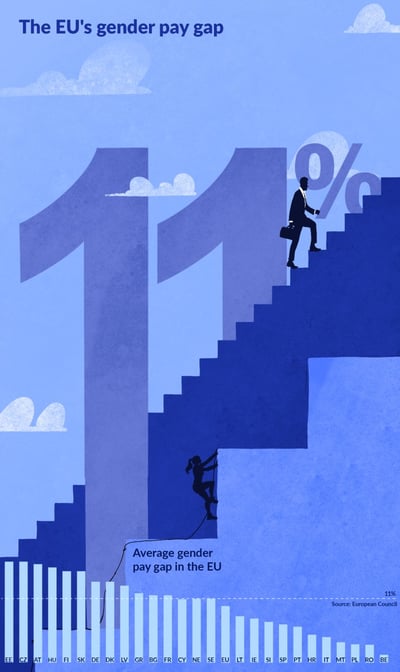
The European Union Treaty establishes the right to equal pay for equal work or work of equal value for women and men. It also makes it clear that it is the responsibility of Member States to enact this principle. However, the gender pay gap has persisted: according to the European Council, in 2024 women earned on average 11% less than men across the European Union – with gaps of over 18% in some countries. This means that women, who account for roughly 46% of the EU workforce (World Bank), are paid on average 89 cents for every 100 cents their male colleagues earn for the same level of effort, seniority, and qualifications. The pay gap leads to an even steeper pension gap, with women being forced to live on 25% less than men at retirement (European Council/Eurostat).
When we have every intent to be fair and just in our employment policies and practices, why has this inequity stagnated for so long?
-
Reason one: The gender pay gap is an example of systemic inequality, meaning it’s so pervasive that it can be difficult to see, while the historic foundation it’s built on makes it impossible to uproot on a piecemeal basis.
-
Reason two: Parenting and other caretaking responsibilities are primarily shouldered by women, leading to income-draining career gaps and lower-paid part-time positions that also progress more slowly.
-
Reason three: Education, social work and health – lower-earning sectors that generate enormous societal benefits – rely heavily on women’s work (76%, according to Eurostat data).
Addressing these systemic issues requires a structural solution. That’s where the EU Pay Transparency Directive comes into play.
Laying the Groundwork
What’s pay equity going to take?
This is the revolution in fairness we’ve all been waiting for. But, like any significant shift, it will require critical observation, careful calibration, and bold, collective action to achieve. For employers, this isn’t just about tweaking your recruiting practices, it’s about reviewing pay structures, updating policies, and ensuring compliance moving forward (if you haven’t started already, now’s your cue).
Observe, quantify, and recalibrate for fairness
It means taking a detailed review of all recruitment processes, compensation packages and structures to ensure that everything, including progression pathways, is based on objective, gender-neutral criteria (that can include performance and competence). It requires a full review and redress of your existing payroll and compensation policies in all markets, using actual pay data. It means examining the value of all bonuses, benefits, paid time off, perks, and professional development, ensuring they are tied to fair, quantifiable metrics. And this doesn’t just apply to full-time hires, but also to part-time staff, fixed-term contract workers, temp agency workers, union employees, and those in management.

Communicate your pay transparency story for maximum impact
Communicating pay transparency internally and externally will support a more transparent and trust-based relationship between employees and employers.
To learn more about how transparency and trust are transforming the candidate experience, read our blog post "A Matter of Trust: How the EU Pay Directive is Reshaping Hiring".
Planning Your Journey
Prepare for Day 1 compliance with the EUPTD Checklist
Given that the Directive takes effect on 7 June 2026, it’s wise to start preparing while waiting for each EU Member State’s transposition. Now is the time to review and establish equitable, justifiable salary ranges for all positions, clarify role requirements and progression criteria, quantify and qualify current compensation, and ensure that your recruiting and retention policies and teams are aligned. You’ll need to be able to report all compensation (base salary, benefits, commissions, and perks) as total annual salary, as required by the Directive.
While the first reporting deadline is 7 June 2027, it requires 2026 data, meaning your HRIS and payroll systems should already be in a position to produce this information in the required format this year. This is not something to leave to chance.
To help you tick the boxes and feel confidently prepared, we’ve designed a step-by-step framework for mapping and documenting this new pay transparency terrain.
Fill out the form to download our Field Guide Checklist and start bringing your EUPTD compliance landscape into focus today.
The Payoff
The EUPTD as a springboard to attraction and retention
We’ve developed this Field Guide for employers not because there’s a lack of helpful resources and perspectives out there, but because we see this process as a genuine opportunity for partnership, growth, and even trendsetting as we travel this route together. The EUPTD is a watershed moment for pioneering employers to stand out in the crowd with transparent policies that support all employees holistically and equitably. It’s not just about being gender neutral in policy and practice, but proactive in redressing inherited systemic inequalities.
The empowerment ecosystem
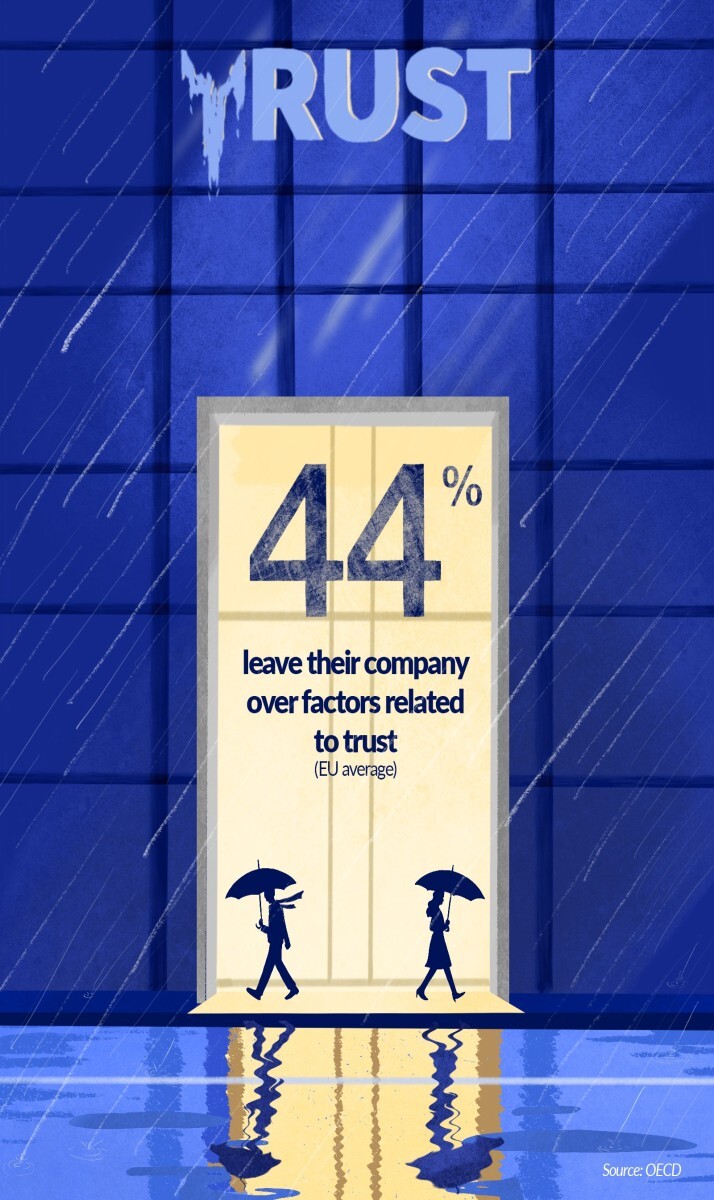
Similarly, it’s not only a matter of company-wide averages, but equity at seniority levels: particularly among managers and in the boardroom. This is where the unadjusted pay gap comes into play: if women are heavily underrepresented in seniority roles, this exposes shortcomings in recruitment, training and visibility opportunities, and career progression pathways. If your group doesn’t anticipate achieving 50-50 at the managerial level in the next five to ten years, then you need to ask why this is the case. If you’re serious about retaining top talent, it’s time to ask these tough questions and have radically honest conversations. The payoff is a renewed culture of mutual trust, loyalty, and goodwill that will reap dividends for attraction and retention.
Would you like to find out how implementing the Directive can revolutionise your employer value proposition? Then read our blog post "Hidden Opportunity: How the EU Pay Transparency Directive Is Changing Candidates’ and Employers’ Mindsets".
Danger on the Trail
Risks of non-compliance
The risks of non-compliance with the Directive are substantial. First and foremost, the burden of proof is now on the employer to respond to an employee claim of unfair pay or job postings that are not gender neutral. Unjustified gender pay gaps of 5% or more will require Joint Pay Assessments with employee representative oversight.
Sanctions and remedies (such as back pay or damages) established by national law can be significant. The EU framework sets a cap of 4% of annual turnover, which could result in millions of euros for some enterprises.
Company reputations are also on the line. In addition to back pay, damages, and fines, companies may be excluded from public bidding for repeat, unremedied violations.

What data does our HRIS need to track so that we can generate compliant payroll reporting?
According to the EUPTD, the following data is required:
- mean and median gender pay gaps for base salary;
- mean and median gender pay gaps in complementary or variable components (such as bonuses, allowances, paid time off, benefits, etc.);
- the proportion of female and male workers receiving complementary or variable components;
- the proportion of female and male workers in each quartile pay band;
- the gender pay gap between workers by category broken down by ordinary basic wage or salary and complementary or variable components.
We operate in multiple EU countries; how do we know which guidelines to follow?
You should ensure compliance with local legislation. EU Member States may introduce stricter requirements where necessary to align with the principle of equal pay. Furthermore, some countries are implementing significantly higher fines and penalties than others. For organisations operating across multiple markets, it is recommended to align company-wide policies and practices with the most stringent requirements across all jurisdictions in which they operate.
My company has fewer than 100 employees; does this apply to me?
Yes, pay‑transparency rights apply to all companies and employees. While only companies with fewer than 100 employees are generally outside the Directive’s initial mandatory public‑reporting bands, EU member states may, under their national laws, impose a mandatory obligation on such companies to provide information on remuneration. Be sure you review your country’s legislation once it is published and keep abreast of any subsequent updates.
Who qualifies as a “worker” under the Directive?
The Directive uses a very broad definition that includes full-time and part-time workers, fixed-term contract employees, and temp agency workers. People in management and union workers are also included. Potentially, categories as disparate as domestic workers, on-demand workers, trainees and apprentices may fall under the Directive’s definition. There will be increased scrutiny of the factual nature of any employment relationship, not just how it is described.

.jpg "GettyImages-2246084894 (1)")